Week 3 — I Built a SOC for My Pool
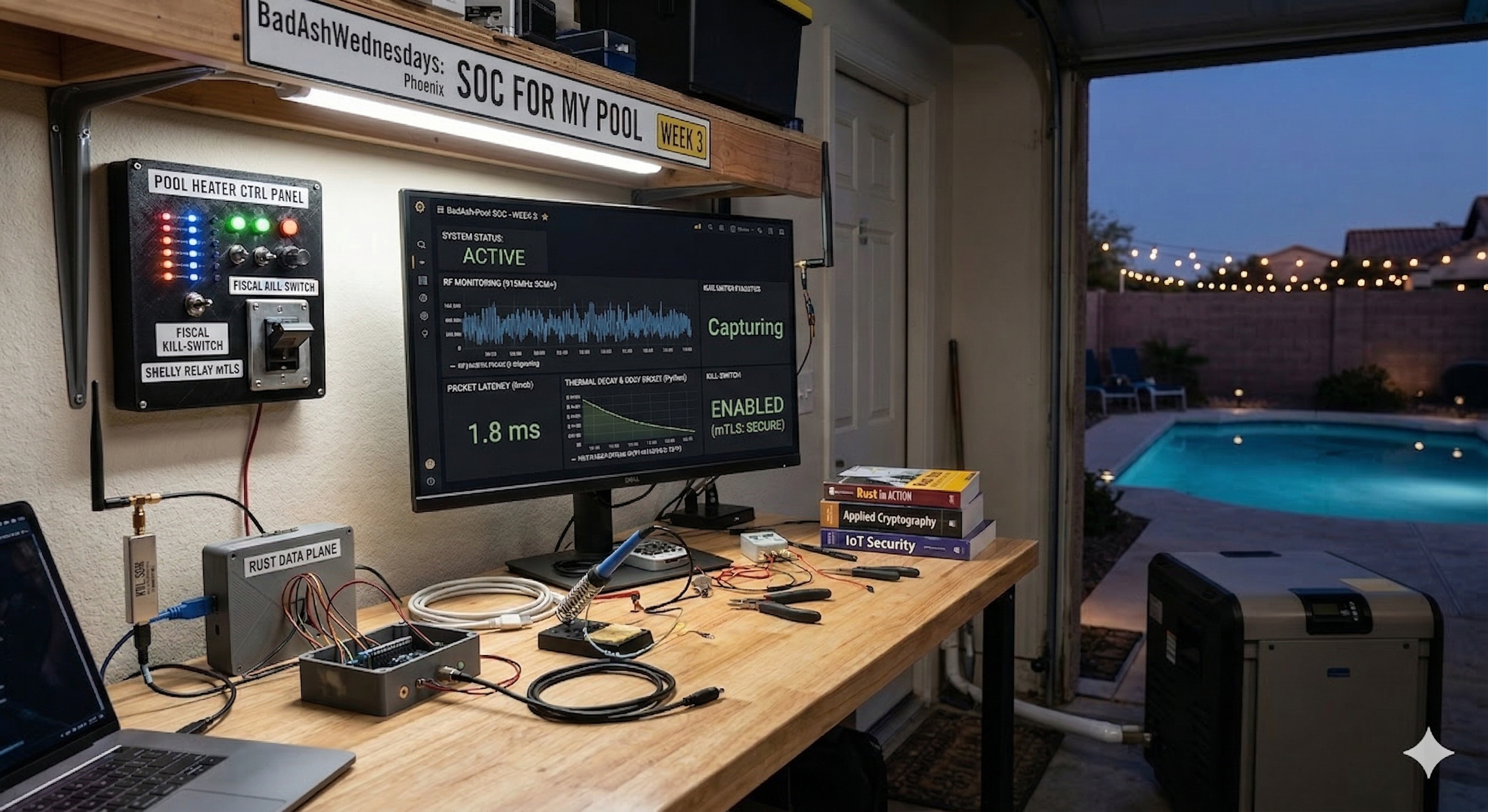
I've been dropping hints the last two weeks. Time to deliver.
I built a security operations center for my pool.
Not a metaphor. A literal observability platform, with an RF ingestor, a thermal decay model, a fiscal kill-switch, and mTLS between every service. All because my gas bill hit $300 last month and I got mad enough to engineer a solution instead of just paying it.
The Problem
Phoenix, AZ. A 250,000 BTU gas pool/spa heater. Southwest Gas at $4.21/hr when the heater runs.
The pool doesn't hold heat overnight. I watched it drop 8.7°F between midnight and 6am on a calm 55°F night in January. Every degree I pre-heat costs money. Every degree I over-heat is money I'll never see again. The stock controller is a thermostat — no awareness of ambient conditions, no awareness of what that temperature will cost to maintain, no awareness of time-of-use.
I'm a security architect. I instrument things. So I instrumented the pool.
Strata Pool Manager (SPM)
SPM is a polyglot IoT system. Not a smart home app. A purpose-built platform with a data plane, an AI logic plane, and a physical actuation layer.
Stack:
- Rust (Tokio + LibUSB) — SDR gas meter ingestor. Data plane. Sub-10ms latency.
- Python (FastAPI + Scikit-learn) — Thermal Decay Engine. AI logic plane. Predictive heating decisions.
- Flutter (Dart) — Mobile dashboard. iOS/Android. The operator console.
- Alpine Linux + K3s — Edge compute node. Minimalist, self-healing, runs on a Raspberry Pi 5.
- TimescaleDB — Time-series telemetry. Every BTU accounted for.
- mTLS everywhere — Zero trust between microservices. Same pattern I deploy for enterprise clients, except the "users" are pool sensors.
The SDR Angle
This is the part that made me actually want to build it.
Southwest Gas smart meters broadcast consumption data over 915MHz RF using the SCM+ protocol. It's a one-way, unencrypted broadcast — the meter yells its data into the air, and the utility truck drives by and listens. No API. No account login. No permission required. RF is public spectrum.
A $35 RTL-SDR V4 dongle with an R828D tuner and a 3.2" dipole antenna can receive those broadcasts. I have mine sitting next to the router, logging my own meter data in real time.
The Rust ingestor decodes the SCM+ packets from raw IQ samples. I'm still learning Rust — this project is the vehicle. The constraint is latency: I want sub-10ms from packet capture to parsed reading in the data plane. Rust earns its complexity budget here. A Python implementation would work, but it would also make me feel bad about myself.
// Not the final impl — but the shape of it
// RTL-SDR → raw IQ → Manchester decode → SCM+ frame parse → meter ID + consumption
More on the actual implementation next week. That deserves its own post.
The Fiscal Kill-Switch
The intelligence layer is where it gets interesting.
The Thermal Decay Engine models pool temperature as a function of ambient temp, wind speed (OpenWeatherMap API), and observed decay rate from the Govee Bluetooth water sensors. Given a target temperature and a current temperature, it calculates: how long will it take to get there, and what will that cost?
If cost-to-target at $4.21/hr exceeds a configurable daily thermal budget — heater gets inhibited.
The physical actuator is a Shelly 1 Gen4 relay wired as a fireman's switch on the heater circuit. SPM doesn't control the heater's thermostat — it controls whether the heater is allowed to run at all. Same concept as a network policy enforcer sitting in front of an application: the app doesn't know or care about the policy, but it can't do anything the policy doesn't permit.
The Shelly talks to the control plane via mTLS. If the API is unreachable, the relay defaults to OFF. Fail-closed. Standard secure design.
Hardware Inventory
Everything I'm using is in hand:
| Component | Role | |-----------|------| | MacBook Pro M3 Pro | Command center | | Alpine Linux VM (Parallels) → Pi 5 | Edge ingestor node | | RTL-SDR V4 (R828D) + 3.2" dipole | 915MHz SCM+ sniffer | | Shelly 1 Gen4 | Fireman's switch / relay actuator | | Govee BT water probes | Pool/spa temp sensors | | OpenWeatherMap API | Ambient + wind telemetry |
Why This Matters Beyond the Pool
I'm using this project to force myself to build things I'd otherwise just read about:
- Rust — I've been avoiding it. No more. The SDR ingestor is the forcing function.
- K3s on Alpine — Kubernetes on the edge, not in a cloud. Minimum viable footprint.
- mTLS in an IoT context — Same zero trust posture I implement for enterprise clients, but with sensor nodes instead of user endpoints.
The security patterns are identical to what I architect for enterprise SASE deployments. The diff is that my pool doesn't have a CISO. I am the CISO. And the pool doesn't care about my feelings when it drops to 68°F at 6am.
What's Next
Week 4 is the Rust SDR ingestor deep dive.
How do you go from raw RTL-SDR IQ samples to a parsed SCM+ frame in Rust? What does the SCM+ packet structure actually look like? What does learning Rust while writing production-grade async I/O code actually feel like?
That's next Wednesday.
BadAshWednesdays is a field log. Real builds, real problems, no tutorials. Week 4: the Rust sniffer goes deep.