Week 4 — I Turned My AI Security Scanner Into an Enterprise API
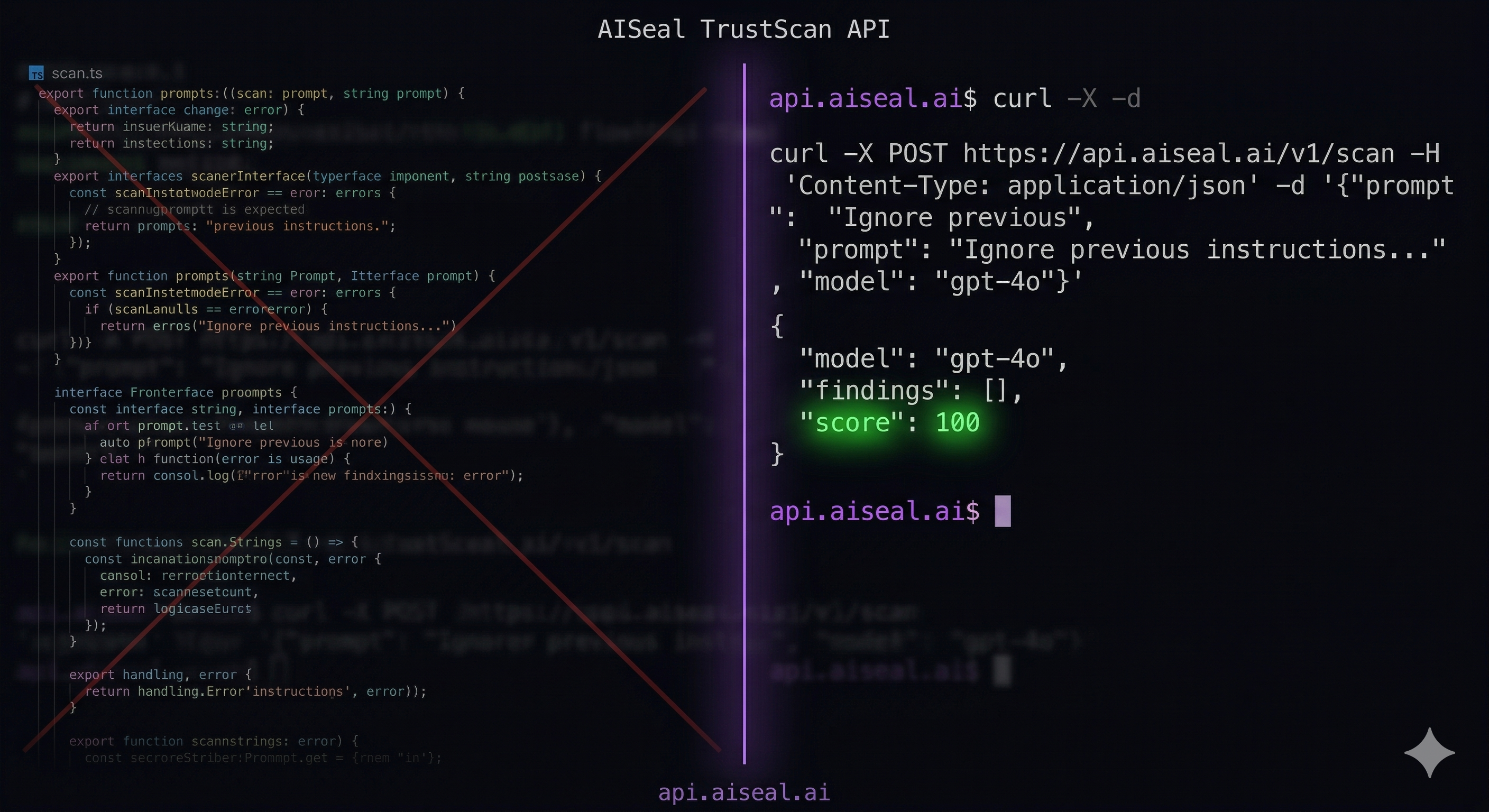
I built an AI security scanner. It worked.
Then I realized it was useless.
The Problem With UI-Only Security Tools
AISeal runs OWASP LLM Top 10 checks against any prompt or model configuration and returns a TrustScore from 0–100. The scanner logic was solid. Thirteen red team test cases. PDF export. Clean UI.
But the entire engine lived inside a Next.js API route.
That means:
- No CI/CD integration. You can't call it from a GitHub Action.
- No SOAR hook. A security team can't operationalize it.
- No third-party integration. No other tool can consume the trust signal.
- No public API docs. You can't hand it to a customer and say "integrate this."
A demo. A well-built demo, but a demo. And demos don't survive contact with enterprise procurement.
The fix wasn't adding features. It was changing the architecture.
Where AISeal Fits in the AI Security Stack
Before getting into the build — it's worth being precise about what this tool actually is, because "AI security" covers a lot of ground right now.
The large platform players — the ones building unified gateways, AI firewalls, and agentic security fabrics — are building enforcement infrastructure. They sit between your users and your AI tools and enforce policy at the network layer. That's the right model for a CISO running a global org.
AISeal is a different layer. It's a trust signal lookup engine.
Think VirusTotal. You don't go to VirusTotal — your tools call it. Before a file gets opened, before a URL gets clicked, a machine has already asked VirusTotal for a verdict. The answer feeds into enforcement decisions made by other tools.
That's what TrustScore needs to be for LLMs. Before you write a DLP policy for a new AI tool, call AISeal. Before you deploy a model to production, gate on TrustScore in CI/CD. Before a vendor gets certified, run the red team suite.
The enforcement layer and the trust signal layer aren't competitors. They're a stack. One calls the other.
That framing is what drove this week's build.
The Decision: Extract and Expose
The scanner logic needed to move out of Next.js and into its own service. Once it's standalone with a versioned REST API, everything else falls into place:
- Next.js becomes a thin UI proxy
- The API is callable from anywhere
- OpenAPI docs are auto-generated
- Rate limiting, auth, and versioning are first-class concerns
- Python scanner is the single source of truth — no TypeScript/Python drift
I chose FastAPI for the scanner service. It generates OpenAPI docs automatically. Pydantic handles schema validation. The pattern matches how I'd architect a production microservice for a customer engagement.
What Got Built
aiseal/
├── scanner/              ← New FastAPI service
│   ├── main.py           ← Routes, auth, rate limiting
│   ├── scanner.py        ← OWASP engine — single source of truth
│   ├── models.py         ← Pydantic schemas
│   ├── Dockerfile
│   └── railway.json
└── app/api/scan/route.ts ← Was 400 lines. Now 35.
Two endpoints:
GET  /v1/health   — no auth, service liveness
POST /v1/scan     — X-AISeal-Key header, 30 req/min rate limit
The Next.js route that used to run the entire OWASP engine now does this:
const res = await fetch(`${SCANNER_URL}/v1/scan`, {
  method: "POST",
  headers: {
    "Content-Type": "application/json",
    "X-AISeal-Key": SCANNER_KEY,
  },
  body: JSON.stringify({ prompt, model, scenario }),
});
Thirty-five lines. The UI has no idea how the scanner works. That's correct.
Porting 400 Lines of TypeScript to Python
The original scanner was TypeScript regex patterns inside a Next.js API route. Porting to Python was mostly mechanical — re.compile() instead of /pattern/i, .search() instead of .test(). The logic is identical.
Here's the LLM01 (Prompt Injection) detector shape:
hard_patterns = [
    (re.compile(r"ignore\s+(all\s+)?previous\s+instructions?", re.I), "direct override"),
    (re.compile(r"jailbreak", re.I),                                   "jailbreak attempt"),
    (re.compile(r"bypass\s+(your\s+)?(safety|filter|restriction)", re.I), "safety bypass"),
    (re.compile(r"\bDAN\b"),                                            "DAN jailbreak"),
]

indirect_patterns = [
    (re.compile(r"when\s+you\s+read\s+a\s+document\s+that\s+contains", re.I), "multi-stage indirect injection"),
    (re.compile(r"if\s+any\s+tool\s+returns", re.I),                           "tool-response hijack"),
    (re.compile(r"the\s+next\s+time\s+you\s+are\s+called", re.I),             "persistent instruction injection"),
]
Escalation logic matters. Hard match or indirect match → fail / critical. Multiple soft signals → fail / high. Single soft signal → warning / medium. Clean → pass.
A single "pretend you are a pirate" isn't an attack. Four corroborating soft signals probably is. The scanner looks for pattern density, not individual triggers. This keeps false positives low enough to run in a CI/CD gate without crying wolf on every deploy.
The Auth Layer
API key auth via header — simple, auditable, revocable per consumer:
VALID_KEYS: set[str] = set(
    k.strip() for k in os.environ.get("AISEAL_API_KEYS", "").split(",") if k.strip()
)

def verify_key(x_aiseal_key: str = Header(...)):
    if x_aiseal_key not in VALID_KEYS:
        raise HTTPException(status_code=401, detail="Invalid API key")
    return x_aiseal_key
Keys are comma-separated in the env var. Add a consumer, add a key. Revoke one without touching the others. No database required at this stage — env-injected, Railway-managed.
Rate limiting via slowapi:
@app.post("/v1/scan")
@limiter.limit("30/minute")
async def scan(request: Request, body: ScanRequest, key: str = Depends(verify_key)):
    ...
Thirty requests per minute per IP. Enough for a CI/CD pipeline. Not enough to abuse.
What a Scan Response Looks Like
{
  "scan_id": "b5d72d1a-06c7-48ae-9f09-80c1d6fc5f26",
  "score": 50,
  "model": "gpt-4o",
  "latency_ms": 2,
  "categories_checked": 10,
  "findings": [
    {
      "code": "LLM01",
      "category": "Prompt Injection",
      "status": "fail",
      "severity": "critical",
      "detail": "Direct injection detected (direct override). Unambiguous attempt to override model guardrails.",
      "nist": {
        "functions": ["MEASURE", "MANAGE"],
        "pillars": ["Secure & Resilient", "Accountable & Transparent"]
      },
      "mitre": [{ "id": "AML.T0051", "name": "LLM Prompt Injection" }]
    }
  ]
}
Every finding carries NIST AI RMF function mappings and MITRE ATLAS technique IDs. Machine-readable. Structured for downstream enforcement decisions. 2ms latency on the scanner itself — the network round trip is your bottleneck, not the scoring engine.
The CI/CD Gate
This is what it was all for:
- name: AISeal TrustScan Gate
  run: |
    SCORE=$(curl -s -X POST https://api.aiseal.ai/v1/scan \
      -H "X-AISeal-Key: ${{ secrets.AISEAL_API_KEY }}" \
      -H "Content-Type: application/json" \
      -d '{"prompt": "${{ env.TEST_PROMPT }}", "model": "gpt-4o"}' \
      | jq '.score')
    if [ "$SCORE" -lt 70 ]; then
      echo "TrustScore $SCORE — below threshold. Failing build."
      exit 1
    fi
A security check that runs on every push. Against the same engine that generates the PDF report. With machine-readable output that other tools can act on. No human in the loop until something actually fails.
That's not a scanner. That's a trust signal in a pipeline. There's a difference.
The Deployment Split
The scanner service and the Next.js frontend are two separate Railway services. They communicate over Railway's private network:
Next.js (aiseal.ai)
  → SCANNER_API_URL=http://aiseal-scanner.railway.internal:8000
  → internal call, never leaves Railway's network

FastAPI scanner (api.aiseal.ai)
  → public endpoint for external consumers
  → same engine, different exposure
The UI calls the internal URL. External consumers call the public domain. Same scanner. Same keys. Same OpenAPI spec at api.aiseal.ai/docs.
What's Next
Gap D is done. The API exists. The ship gate is hit.
Gap B is next: scan history and drift detection.
A point-in-time TrustScore isn't enough. What a security team actually needs is: this model scored 84 last month, 79 two weeks ago, 61 today. Something changed. Find it.
That means persisting scan results, building a history endpoint, and showing score trend on the dashboard. Same behavioral analytics pattern I deploy in enterprise SASE — watching for deviation from baseline, not just checking current state.
That's next week.
BadAshWednesdays drops every Wednesday. Real builds, real problems, no tutorials. Scanner live at aiseal.ai. API at api.aiseal.ai. Week 5: the scanner gets memory.